
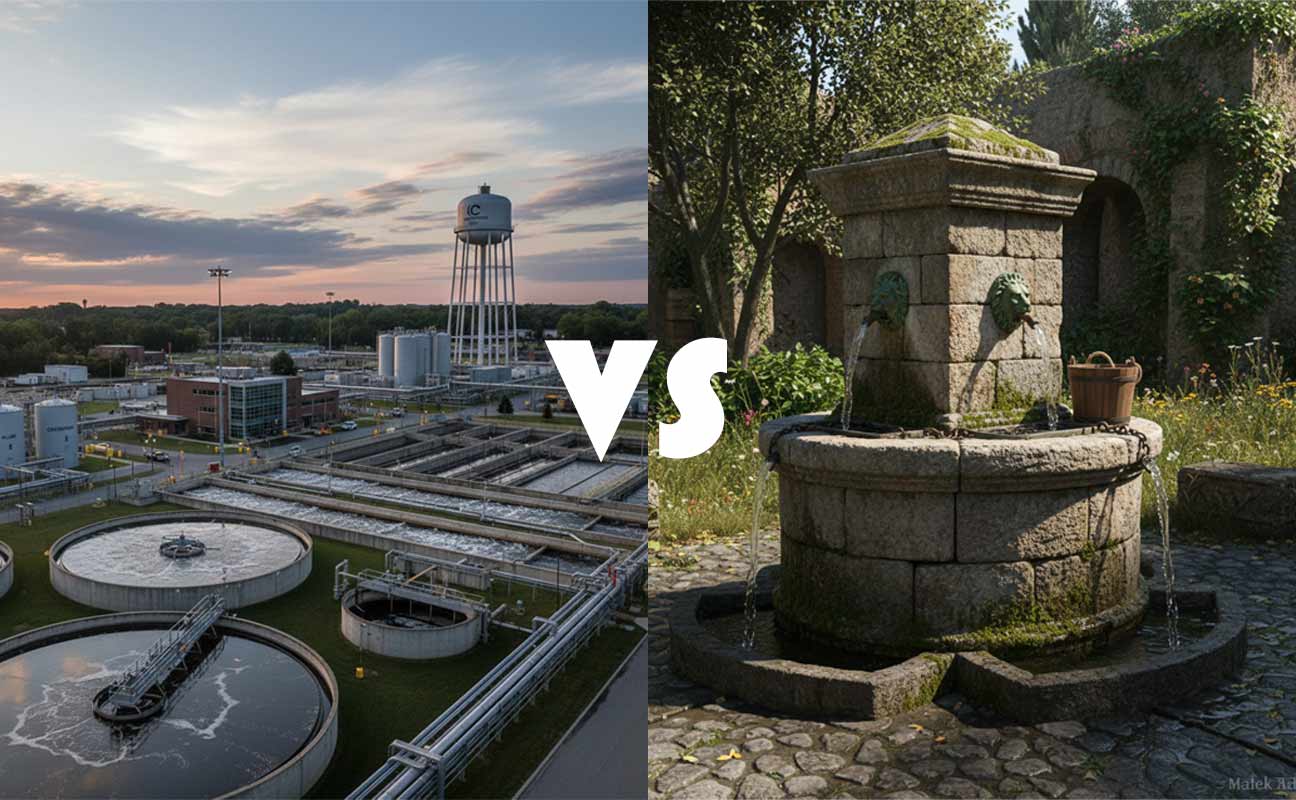
Choosing a reverse osmosis system starts with one key question: Where does your water come from?
City (municipal) water and private well water look similar in a glass, but they need very different RO system setups to run smoothly and protect the membrane.
Why source water matters
An RO system is excellent at removing dissolved salts and many contaminants. But it isn’t a catch-all. If chlorine, iron, or heavy sediment reach the membrane, performance drops fast. Good pretreatment and the right RO filters make the difference between a system that “just works” and one that constantly clogs or fails.
Municipal water (city water): what it means for design
What’s typical
-
Stable quality
-
Chlorine or chloramine present
-
Moderate hardness, usually low turbidity
What to do
-
Use carbon (GAC or catalytic carbon) to remove chlorine/chloramine before the membrane. Aim for zero at the RO inlet.
-
Use a simple sediment ladder of RO filters: 20 μm → 5 μm (string-wound cartridges work great).
-
Add UV if water sits in a storage tank or you want extra microbiological protection.
-
For drinking or coffee, add remineralization after the RO to improve taste and stabilize pH.
Well water (private borehole): what it means for design
What’s typical
-
No disinfectant
-
Can include iron (Fe), manganese (Mn), hardness, H₂S odor, bacteria, tannins, silica, and CO₂
-
Quality can change with seasons and rainfall
What to do
-
Oxidize and filter iron/manganese (air, chlorine, or hydrogen peroxide → contact tank → MnO₂ media like Greensand/Katalox).
-
Control hardness with a softener or antiscalant so you can run higher recovery without scale.
-
Use a stronger sediment ladder: 50 μm → 20 μm → 5 μm (add 1 μm if colloids are stubborn).
-
Add UV for biofouling control.
-
Consider degassing if CO₂ is high (it can make RO water acidic). Follow with calcite to raise pH.
A robust, practical stack
50 μm string-wound → oxidant injection + contact → MnO₂ media → 20 μm string-wound → GAC → softener or antiscalant → 5 μm string-wound → UV → high-pressure pump → RO system → (degassing if high CO₂) → calcite/remineralization → storage + final UV
The one rule you can’t skip: protect the membrane from oxidants
Polyamide RO membranes are damaged by chlorine and chloramine.
-
Target zero chlorine/chloramine at the RO feed (check with DPD test or an online meter).
-
Use GAC or catalytic carbon with enough contact time (about 2–3 minutes for chlorine, 3–5 minutes for chloramine).
-
A small “last-chance” carbon cartridge right before the RO is cheap insurance.
-
Sodium metabisulfite can polish free chlorine, but don’t rely on it alone for chloramine.
Build your pretreatment ladder (coarse → fine)
-
Sediment
-
Municipal: 20 μm → 5 μm string-wound RO filters
-
Well: 50 μm → 20 μm → 5 μm (add 1 μm if needed)
-
String-wound cartridges = high dirt holding, low pressure drop, long life
-
-
Chlorine/organics
-
Municipal: catalytic carbon is best for chloramine; GAC/carbon block for chlorine and VOCs
-
Well: GAC for organics/tannins; try anion resin if tannins persist
-
-
Scale control
-
Softener (simple and effective) or antiscalant dosing (flexible, needs correct dosing)
-
Set safe recovery using vendor projection software
-
-
Iron/Manganese (well)
-
Oxidize → contact tank → MnO₂ media → then sediment filters
-
-
Microorganisms
-
UV before RO reduces biofouling; UV after storage protects drinking water
-
Recovery and scaling
-
Higher recovery means less wastewater, but higher scale risk.
-
Hard water favors a softener. It often pays back by letting your RO system run higher recovery and by extending membrane life.
-
Silica gets tricky above ~20–40 mg/L. Follow your antiscalant’s limits or lower recovery.
-
Remember: higher TDS raises osmotic pressure, so your pump must deliver enough net driving pressure for healthy permeate flow.
Sizing and changing RO filters
-
Choose string-wound polypropylene sediment filters in 10”, 20”, 30”, or 40”, sized to your flow.
-
Change sediment filters when pressure drop rises by about 0.7–1.0 bar (10–15 psi), or when they look loaded.
-
Size carbon by contact time, not just flow. For chloramine, plan 3–5 minutes EBCT (bigger carbon beds beat small blocks at high flow).
Post-treatment for taste and safety
-
Remineralization (calcite or calcite/corosex) to lift pH and alkalinity for better taste and non-corrosive water.
-
Degassing if well water has high CO₂ (fixes acidic permeate).
-
Point-of-use UV if water is stored or sits in lines.
What to test before buying or redesigning an RO system
Ask for a full water test (municipal or well):
-
Disinfectant: free chlorine and total chlorine (chloramine)
-
Metals: iron, manganese, barium, strontium
-
Basics: pH, alkalinity, hardness, TDS, temperature, turbidity, SDI
-
Ions: sulfate, chloride, nitrate, fluoride, silica
-
Organics: TOC, tannins (if there’s color)
-
Micro: HPC/coliforms (especially for wells)
-
Gases: H₂S, CO₂
Good RO feed targets: SDI < 3, turbidity < 0.5 NTU, Fe < 0.1 mg/L, Mn < 0.02 mg/L, chlorine/chloramine = 0.
Ready-to-use example builds
A) Café on municipal water
-
Pretreatment: 20 μm string-wound → catalytic carbon → 5 μm string-wound → UV
-
RO: 200–400 GPD reverse osmosis system with permeate pump
-
Post: remineralization for espresso taste and machine protection
B) Family home on well water
-
Pretreatment: 50 μm string-wound → oxidant + contact → MnO₂ media → 20 μm string-wound → GAC → softener (if hardness > 200 mg/L) → 5 μm string-wound → UV
-
RO: 400–800 GPD RO system (use antiscalant if you skip the softener)
-
Post: degassing if CO₂ is high + calcite cartridge
C) Bakery/food service on municipal water
-
Pretreatment: multimedia filter (if SDI high) → 20 μm string-wound → twin GAC vessels (in series) → 5 μm string-wound → UV
-
RO: 2× 4040 elements, VFD pump, 60–70% recovery
-
Post: light blend to target TDS; storage + recirc UV
Simple maintenance checklist
Print this and tape it near the RO system:
-
Weekly: Log permeate flow, TDS, feed and concentrate pressure, ΔP across RO. Confirm zero chlorine before the RO.
-
Monthly: Check SDI, replace RO filters (sediment/carbon) based on pressure drop or capacity, confirm antiscalant dosage.
-
Quarterly: Normalize membrane performance (flux and salt rejection).
-
As needed: CIP (alkaline clean for organics/biofilm; acid clean for scale). Rinse thoroughly and stay within temperature/pH limits.

I’m not sure why but this weblog is loading incredibly slow for me.
Is anyone else having this problem or is it a issue on my end?
I’ll check back later on and see if the problem still exists.
Thanks for finally writing about > Clear guide to designing an RO system for
municipal vs. well water – PORTUGOTA < Liked it!